
FOR IMMEDIATE RELEASE
Patience Is a Virtue With Wet Springs
Don’t panic if your spring forecast is wet, cautions LG Seeds agronomist.
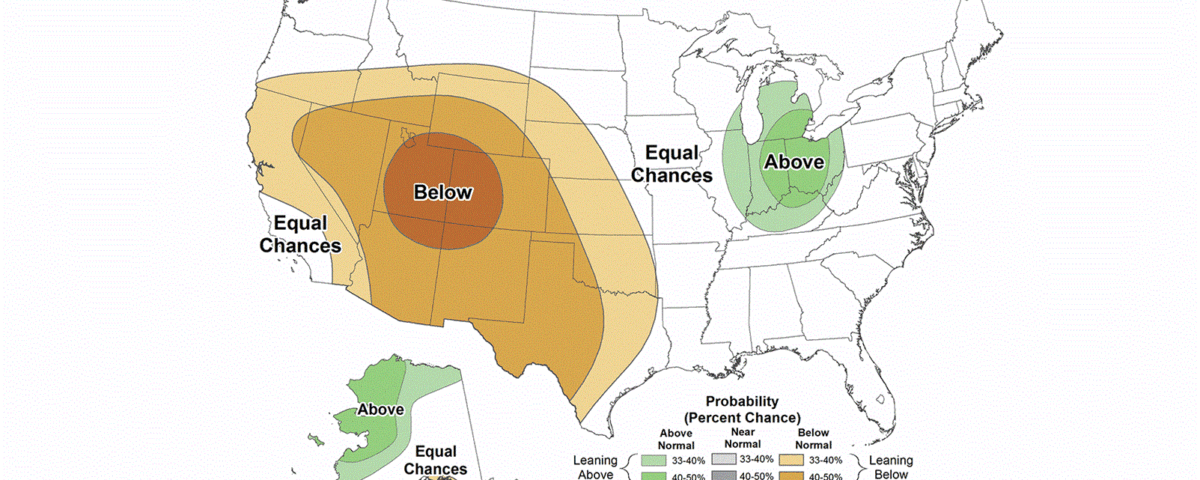
WESTFIELD, Ind. (April 3, 2025) – With the National Oceanic and Atmospheric Administration (NOAA) predicting elevated odds of a wet spring in the eastern Corn Belt, even the most seasoned growers are antsy to get planting.
“With many growers facing thin margins, they certainly don’t want to be faced with a difficult replant decision,” says Landon Taylor, LG Seeds agronomist. “And if it’s a wet spring, we may only get one shot.”
Seeing the latest NOAA reports, Taylor is encouraging his corn and soybean growers to be patient and avoid heading into the field too early, helping them evade the pitfalls of a wet spring.
Much of the eastern Corn Belt has elevated odds of a wet spring, according to the National Oceanic and Atmospheric Administration.
How does this impact planting?
Planting dates typically vary among Taylor’s geographies — Illinois, Indiana, Kentucky and Tennessee — and each state is predicted to have above-average precipitation.
“We can’t get out there when the fields are muddy,” says Taylor. “Without that good seed-soil contact, you’ll likely see uneven emergence, lateral roots and nodal root issues later on.”
Studies have shown a yield advantage for corn and soybeans with earlier planting dates. However, Taylor stresses how optimal planting times depend on the season, so growers should use ground temperatures as their guide, not the dates on the calendar.
“We always get our crop into the ground,” encourages Taylor. “If it is raining heavy or you’ve got a lot of anxiety before planting, stay patient and stay busy.”
Double-check your equipment
One way to pass the time before planting is ensuring your planter is working appropriately. Taylor says to check anything that shakes, moves or spins — from closing wheels to opening discs and even your row cleaners.
“If it’s wobbling a little, if the spacing is off, all of that matters to the seed going into the ground,” says Taylor. “Every time it’s even a fraction of an inch off or we have a skip or a double, that can take away yield potential.”
Checking equipment also helps stop you from creating further soil compaction issues. “Especially this spring, check behind the planter as often as possible and adjust the planter as you move from field to field,” says Taylor.
Prepare for increased pest pressure
A wet spring also makes a prime environment for disease development. Growers should watch out for diseases like pythium, which only needs a few hours of standing water to develop. Taylor says to anticipate other soil-borne and early-season pests and consider a nematicide or premium seed treatment if planting in cool, wet soil is your sole option.
Increased weed pressure also follows a wet spring, so residuals will be key. “If you have an opportunity to spray, there’s rain coming or you haven’t been in the field in a while, go ahead and put a residual down,” says Taylor.
“The more water you have, the less likely that residual will last in the soil,” he continues. “Layer your residuals to keep the weeds out.”
Regardless of what pest pressures may arise, frequent scouting for in-season threats is necessary. “The best thing you can do for your crop is to cast a shadow over your field,” says Taylor.
Be patient
Taylor’s final advice for growers regarding this wet spring? Have faith.
“I like to see the crop sit in the ground for 48 hours before it rains,” Taylor says. “If you know a heavy rain event is coming, you shouldn’t be planting all the way up until rain clouds cover the sky. Have faith that it’s going to dry up, be patient and wait. You’ve got time.”
Reach out to your local LG Seeds agronomist to optimize your seed plans for any upcoming pest pressure, weather conditions or other crop management concerns.
###
Contacts:
Ashley Davenport | Ashley.Davenport@AgReliantGenetics.com | 574-780-0203
Julianne Johnston | jjohnston@morganmyers.com | 319-233-0502
The information and statements contained in this release are merely for informational and educational purposes and do not guarantee future performance.
ALWAYS READ AND FOLLOW IRM, WHERE APPLICABLE, GRAIN MARKETING AND ALL OTHER STEWARDSHIP PRACTICES AND PESTICIDE LABEL DIRECTIONS.
The LG Seeds Design and AgriShield are registered trademarks of AgReliant Genetics, LLC.
©2025 AgReliant Genetics, LLC.


