

FOR IMMEDIATE RELEASE
It’s Report Card Time: Check Your Corn Roots
A corn plant’s root system helps tell a more complete story of how the season played out.
WESTFIELD, Ind. (Oct. 7, 2024) – If you have a field or an area of the field that’s underperforming, you should get out a shovel and investigate, says LG Seeds Agronomist Jed Norman. As the close of the growing season nears, the roots act as a final report card.
“They help tell a more complete story of the growing season,” Norman says. “And in some cases, they can alert farmers to issues they didn’t even realize they had — issues that could worsen if not addressed.”
Root digging tips
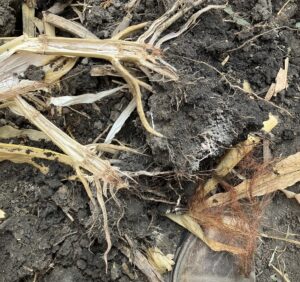
When digging roots, make sure to split them open. A healthy pith will be white and strong.
When digging up corn roots late in the season, Norman encourages farmers to sample from several areas of the field — specifically, an area that’s high yielding, an area that’s lower yielding and an area that’s average on yield. That helps tell a more complete story.
He advises farmers to dig up roughly 10 plants from each of those spots. “An 8-inch-by-8-inch area will give you a good root ball to look at,” he details. Anything smaller will likely prune roots.
Corn root system checks
There are three main things Norman looks for when conducting these early-fall root digs: insect damage, disease pressure and root growth issues.
“When I’m looking at roots, I’m looking for signs of feeding,” Norman explains, noting corn rootworm pressure has been significant in recent years. These pests feed on roots and cause injury to corn. Farmers should check whether corn plants still have all five sets of nodal roots.
Norman also examines corn roots for signs of disease. That might include discoloration, decay or a softening of roots. He encourages farmers to split the root in half to check whether the main feeding pathway for the plant looks healthy, white and strong all the way to the crown.
Root growth is another factor Norman evaluates. “Check whether corn roots went down deep into the soil or if they feathered out to form more of a mohawk,” he says. “Sidewall compaction or hardpan resulting from wetness during planting can cause roots to feather out rather than stretching down deep into the soil.”
Applying those belowground findings
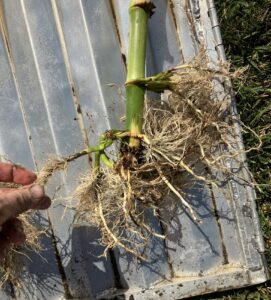
Roots can show evidence of corn rootworm feeding.
Equipped with a better idea of what went well and/or what didn’t, farmers can start planning how to overcome any issues or tweak management to realize even more yield potential next season. Hybrid selection is one of farmers’ main tools for overcoming problems.
If farmers are dealing with insect pressure, they may be able to incorporate traits that offer protection. If roots tip a farmer off that disease is moving in, that field might be one to monitor closely and harvest early.
And of course, awareness of disease, insect pressures and soil conditions should inform a farmer’s hybrid selection for the coming season. “If you know you have tighter clay soils or some hardpan in a field, you may want to choose a hybrid with a more penetrating root that will be able to work down to get to water and nutrients,” Norman says. Hybrid selection is very important in challenging environments.
“Farmers don’t want to point fingers at something or spend money on a possible fix unless they know what the issue is,” Norman says. Corn’s root system can help clarify issues so a farmer can troubleshoot with purpose.
For support using root dig results to make the best hybrid choices for any acre, reach out to your local LG Seeds agronomist.
###
Contacts:
Ashley Davenport | Ashley.Davenport@AgReliantGenetics.com | 574-780-0203
Julianne Johnston | jjohnston@morganmyers.com | 319-233-0502
The information and statements contained in this release are merely for informational and educational purposes and do not guarantee future performance.
ALWAYS READ AND FOLLOW IRM, WHERE APPLICABLE, GRAIN MARKETING AND ALL OTHER STEWARDSHIP PRACTICES AND PESTICIDE LABEL DIRECTIONS.
AgriGold® and Design® and Field GX™ are trademarks of AgReliant Genetics, LLC.
©2023 AgReliant Genetics, LLC.


