
FOR IMMEDIATE RELEASE
Manage Your Way Out of Corn Rootworm
Controlling the pest takes planning and a combination of tactics, says AgriGold agronomist.
WESTFIELD, Ind. (August 19, 2024) – Is it possible to get rid of corn rootworm? Absolutely, says AgriGold Agronomist Ron Roling. Hailing from eastern Iowa, the self-proclaimed corn rootworm capital of the world, Roling is well versed in what it takes to protect corn yields from the destructive pest.
“There’s no rescue treatment,” Roling says. “But farmers can eliminate corn rootworm with a six- to 10-year plan of attack using a combination of management tactics.”
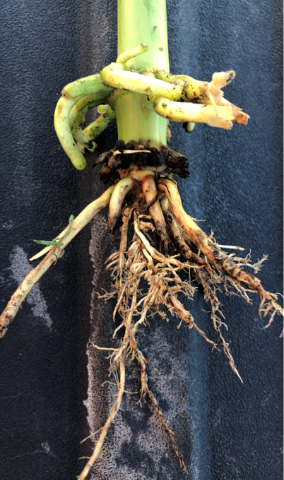
Root feeding by corn rootworm in the larvae stage can leave plants vulnerable to other issues down the road.
Corn rootworm pressure expected to be high
Populations of corn rootworm have exploded in recent years. “After the mild winter, there’s bound to be a lot more rootworm pressure,” Roling warns. In North America, farmers fight three main species of corn rootworm: northern corn rootworm, western corn rootworm and southern corn rootworm.
In the larval stage, corn rootworm can damage plants via extensive root feeding. In heavy rootworm infested areas, it’s not uncommon to find one or even two of the corn plant’s three root nodes chewed away. That limits water and nutrient uptake, weakening the corn plant and leaving it vulnerable to other issues, like lodging.
Around the time lightning bugs appear, corn rootworm larvae hatch and begin feeding on roots. Later in the season, the larvae become beetles that feed on silks and can compromise pollination. While farmers can’t do much to solve the problem at this point, they can use sticky traps to assess pressure and make plans for corn rootworm control next season.
Roling encourages farmers to monitor later planted and replanted corn fields closely, especially if surrounding fields were planted in a timely manner. “Corn rootworm beetles are attracted to fields with the greenest vegetation and best food sources,” he says. “Look for silk clipping in those fields and consider crop rotation next year.”
All of the above strategy for corn rootworm management
The best strategy is a combined effort of ALL the management strategies for the next six to 10 years, Roling says. That plan should include rotating products that include protections that defend against corn rootworm, incorporating a soil-applied insecticide, beetle bombing and rotating to soybeans for at least a year.
Corn hybrid selection is also key when managing corn rootworm. “One of the strengths of AgriGold’s lineup is multiple aboveground and belowground traits on our hybrids,” Roling says. “We’re able to use multiple traits and insecticides over that six- to 10-year plan period. That’s critical for corn rootworm resistance management.”
Crop rotation is another important defense. “At least one of those plan years should be a year of soybeans,” Roling says. Corn-on-corn acres are common in his area of the state. “Planting soybeans for a year can knock corn rootworm population down to zero and keep it there with the corn rootworm management system.”
During that year of soybeans, Roling says it’s critical that farmers manage weeds and volunteer corn, which are hosts for corn rootworm.
Be strategic with bug bomb timing
In addition to soil-applied insecticide, farmers in high-pressure areas should also consider a well-timed beetle bomb, Roling says. While farmers would prefer to spray their foliar insecticide when they’re doing a fungicide application, that’s not always the best timing. Male beetles emerge around that time, but female beetles emerge several weeks later.
Doing your beetle bomb at the same time as your fungicide might be convenient, but it isn’t the most effective timing, Roling explains. “Farmers have better results doing their beetle bomb a few weeks later when egg-laying females emerge.”
A long-term, systems-based approach can rid fields of corn rootworm. For support putting a management plan together or making corn hybrid decisions for fields with corn rootworm, reach out to your local AgriGold agronomist.
###
Contacts:
Ashley Davenport | Ashley.Davenport@AgReliantGenetics.com | 574-780-0203
Julianne Johnston | jjohnston@morganmyers.com | 319-233-0502
The information and statements contained in this release are merely for informational and educational purposes and do not guarantee future performance.
ALWAYS READ AND FOLLOW IRM, WHERE APPLICABLE, GRAIN MARKETING AND ALL OTHER STEWARDSHIP PRACTICES AND PESTICIDE LABEL DIRECTIONS.
AgriGold® and Design® and Field GX™ are trademarks of AgReliant Genetics, LLC.
©2023 AgReliant Genetics, LLC.


