

FOR IMMEDIATE RELEASE
Three Key Practices to Tackle Corn Rootworm
Integrated approach controls pests and protects yields
WESTFIELD, Indiana (Dec. 13, 2023) – A persistent pest and long-standing challenge in Midwest fields, corn rootworm is still impacting yields today. Steve Crafton, an LG Seeds agronomist in northern Illinois, has been battling corn rootworm for the entirety of his 30-plus-year career.
The damage caused by corn rootworm can lead to yield losses due to reduced nutrient uptake, lodging and compromised root systems. “Corn rootworm can cause up to three nodes of root loss — this year I saw 1 to 1.5 nodes of roots eaten off, on average,” reports Crafton.
To help combat the pest, Crafton encourages farmers to adopt an integrated approach, utilizing three key management practices. “The three strategies I recommend are crop rotation, planting the right hybrids containing the right traits, and insecticide application if needed,” he says.
Crafton explains why these practices are necessary to control this yield-robbing pest.
#1: Rotate to non-host crops
Continuous planting of corn in the same fields allows rootworms to thrive. “When I see big spikes in rootworm beetle counts, it’s often in continuous corn fields,” adds Crafton.
Introducing a non-host crop into the rotation, such as soybeans, removes the pest’s consistent food source and breeding ground, breaking the life cycle and reducing populations.
“Corn rootworm eggs can overwinter for several seasons, so crop rotation shouldn’t be your only method of management,” states Crafton.
#2: Select the right traits and hybrids
The next line of defense for managing corn rootworm, Crafton says, is planting a hybrid with rootworm defense traits for above- and below-ground protection.
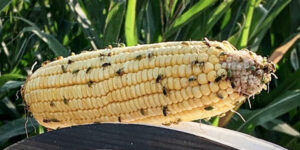
Corn rootworm beetle damage can lead to yield losses due to reduced nutrient uptake, lodging and compromised root systems
“LG Seeds offers three trait options with multiple modes of protection to defend against corn rootworm larvae: including Agrisure Duracade®, SmartStax® and SmartStaxPRO®,” he shares.
Crafton stresses the importance of selecting strong-rooted hybrids as well: “Even the most powerful trait on the market will fail if paired with a weak-rooted hybrid. LG59C72 is a good hybrid with strong roots and good tar spot tolerance and has a strong history of performance in the I-80 corridor area. LG64C20 and LG56C25 have also done very well.”
To preserve efficacy and prevent resistance, Crafton says it’s imperative to rotate traits. “My suggestion is to start with hybrids containing the Agrisure Duracade® trait on your first year of corn and in your heavy rootworm infested areas. Then, switch to a hybrid containing the SmartStaxPRO® or SmartStax® trait,” he explains.
#3: Reduce populations with insecticides
While traits offer root protection, the addition of insecticides enhances control, especially in areas where rootworm pressure is high or when traits might be less effective due to resistance.
Soil insecticides at planting or as a post-application can be effective to control corn rootworm larvae and give broad spectrum control of other soil-borne insects. “If there’s a heavy beetle infestation, applying a foliar insecticide — along with your fungicide application — will help target adults and cut down populations,” he says.
Combining insecticides with other management practices for an integrated approach is more sustainable and effective in the long term.
Work with an agronomist
Crafton suggests that farmers work with their agronomist for planting decisions and evaluating success throughout the year.
“Have an agronomist involved in your seed plan for trait rotation and to get the right product mix,” he says. “After planting, scout for rootworm beetles around pollination time and again a couple weeks later.”
The insights gained from evaluating what traits and hybrids are performing well contribute to an even better plan for the following year.
“LG Seeds gives farmers flexibility to fight resistance through trait rotation,” says Crafton. “We provide high-performing hybrids with strong roots, paired with the trait protection needed for high performance and protection against corn rootworm.”
For details on all the trait choices available from LG Seeds, visit lgseeds.com.
###
ABOUT LG SEEDS
LG Seeds is a dealer-driven national seed brand offering solid agronomic support, straightforward service and consistent plant performance that yields. LG Seeds’ portfolio of broad trait choices and tailored genetics brings corn, soybean, sorghum and alfalfa products to fit farmers’ performance goals. For more information visit LGSeeds.com and follow us on Facebook, Twitter, Instagram and LinkedIn.
ABOUT AGRELIANT GENETICS
AgReliant Genetics is committed to providing trusted seed solutions that help farmers grow. We do this by focusing solely on seed and delivering one-of-a-kind, high-performing hybrids. Founded in 2000 by global seed companies KWS and Limagrain, AgReliant Genetics benefits from direct access to a global corn germplasm pool and has a top four corn research program. Through our seed brands, AgriGold® and LG Seeds in the U.S. and PRIDE® Seeds in Canada, we proudly offer the latest innovation to our farmer customers, whether they grow corn, soybeans, sorghum or alfalfa. Discover more at AgReliantGenetics.com.
Contacts:
Ashley Davenport | Ashley.Davenport@AgReliantGenetics.com | 574-780-0203
Julianne Johnston | jjohnston@morganmyers.com | 319-233-0502
The information and statements contained in this release are merely for informational and educational purposes and do not guarantee future performance.
The LG Seeds Design and AgriShield are registered trademarks of AgReliant Genetics, LLC.
©2023 AgReliant Genetics, LLC.


