

FOR IMMEDIATE RELEASE
LG Seeds Announces 19 New Corn Hybrids, 23 New Soybean Varieties for 2023 Planting
Farmers need to do all they can to limit bad days, says LG Seeds agronomist
WESTFIELD, Indiana (July 13, 2022) – Farmers in northern Iowa might have been frustrated with delayed planting this spring, but the silver lining is this helped avoid some early season diseases that favor cool, wet soils, says Jed Norman, LG Seeds agronomist in north-central and northeast Iowa.
Farmers in the region have had great success planting soybeans in April in recent years, but that didn’t happen in 2022. “Farmers took advantage of prime conditions the second week of May to get soybean seed in the ground,” says Norman. That timing was key, he says, noting Iowa State University data signaling soybeans should avoid a yield drag until May 20.
Soybeans are generally off to a good start and around the V3 to V4 stage of development as of early July, Norman reports. Now that the busy June period of herbicide spraying has passed, he says there can be a tendency to skip ahead to harvest preparations. But he warns against complacency and encourages farmers to keep scouting for weed and insect pressures.
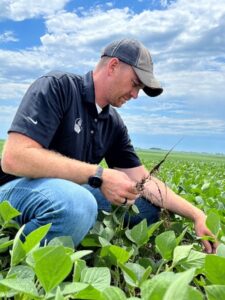
Soybeans are off to a good start in northern Iowa, but farmers need to stay focused on helping the crop reach its full yield potential, says Jed Norman, LG Seeds agronomist.
“Soybeans started flowering around the summer solstice. This should remind farmers to do whatever they can to help the plant keep growing vegetatively and finish strong,” Norman says. “Beans can take a bad day up until they flower, but we don’t want them to have a bad day after flowering begins.”
Common threats to soybean health
Common threats for northern Iowa soybeans include Septoria brown spot, white mold and frogeye leaf spot. In early July, Norman was also digging soybean plants and checking roots for soybean cyst nematode (SCN). “I found plenty of white females on roots to tell me we will need to change management practices on those fields the next time they are planted to soybeans,” he says. “These farmers need to look at rotating SCN resistant varieties and adding a nematode-protectant seed treatment.”
Sudden death syndrome (SDS) has also plagued soybean producers for nearly a decade, Norman says. “August is a good time to split open some stalks and dig up roots to assess risk for SDS,” he says. The related pathogen causes discoloration inside the stalk and blue pigmentation on the root mass.
Farmers should also watch for nutrient deficiencies, which he is seeing in his territory. “The plant will tell you exactly what’s going on in terms of nutrient deficiencies,” Norman says. He encourages farmers interested in diving deeper into plant nutrition to pursue tissue sampling.
Potential solutions for protecting yield
Norman is a firm believer in layering herbicide residuals. “Apply products that will hang on through the growing season and keep fields clean.”
Some farmers who dealt with downed corn last season have another foe: volunteer corn. “Now is a good time to evaluate and address those volunteer corn issues before they become a big problem,” Norman says. He reminds volunteer corn serves as a host for corn rootworm beetles and cites University of Nebraska-Lincoln research showing volunteer corn at a density of 3,500 plants per acre can cause up to a 10% yield reduction.
“Be aggressive. Evaluate and scout fields. Make sure you’re using a herbicide rate sufficient to get a good kill,” he advises.
A well-timed fungicide and insecticide application can also help stave off bad days for the soybean crop. “Apply the fungicide and insecticide around the R3 beginning pod stage and scout from there,” Norman advises. “With the fungicide, you get the canopy cooled off a bit, let it respirate and keep bugs away.”
Prepare for the next season during lulls
Norman hopes for timely rains in August during pod fill. This is also a great time to prepare for next season. “Take good notes that set you up for the year ahead,” Norman recommends. “You can assess disease pressures and manage those issues with soybean variety and seed treatment selections.”
He encourages producers to rotate host crops, herbicides and traits to prevent resistance issues. “You want to keep pests and weeds guessing,” he says.
LG Seeds agronomists are available to help with decision making to ensure farmers get the right genetics on the right acre and the right trait pairing for a farm’s unique challenges. “LG Seeds is passionate about making sure customers get the right combination for their farms and their yield goals,” Norman says. “We love gearing farmers up for success.”
###
ABOUT LG SEEDS
LG Seeds is a dealer-driven national seed brand offering solid agronomic support, straightforward service, and consistent plant performance that yields. LG Seeds’ portfolio of broad trait choices and tailored genetics brings corn, soybean, sorghum, and alfalfa products to fit farmers’ performance goals. For more information visit LGSeeds.com and follow us on Facebook, Twitter, Instagram and LinkedIn.
About AgReliant Genetics
AgReliant Genetics offers unparalleled corn, soybean, sorghum, and alfalfa seed solutions to bolster the yield and profitability goals of growers across North America through product brands AgriGold® and LG Seeds in the U.S. and PRIDE® in Canada. AgReliant supplies diverse genetics to the market through access to a broad germplasm pool in close collaboration with parent companies KWS and Groupe Limagrain. The team takes pride in its seed innovations, market responsiveness and investments in the communities they serve.
AgReliant Genetics and Design, AgriGold, and PRIDE are registered trademarks of AgReliant Genetics, LLC and its related companies.
###
Contact:
Amanda Fruland, Amanda.Fruland@agreliantgenetics.com


