
FOR IMMEDIATE RELEASE
Evaluate Your Nitrogen Needs to Maximize Yield
Nitrogen management is a balancing act, says LG Seeds agronomist.
WESTFIELD, Ind. (June 10, 2025) – A main driver of yield, finding the correct nitrogen balance is critical — especially this season.
“In a year like this where we’re looking to cut costs but not lose yield, it’s important to look at your nitrogen management plans,” says LG Seeds Agronomist Alex Cox. “Wasting money on excess nitrogen would be a big loss — you’re throwing money away.”
Conversely, nitrogen deficiency can cause significant yield loss. “That’s why you have to plan ahead and estimate your total nitrogen needs before the season even starts,” says Cox. “You need to check fields regularly for nitrogen deficiency to protect profits.”
Scout for deficiency signs
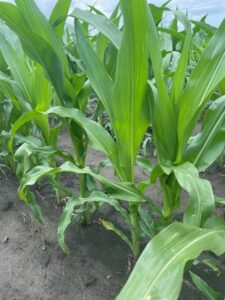
Growers should scout the lower corn leaves for signs of nitrogen deficiency like yellowing, says LG Seeds Agronomist Alex Cox.
Cox says growers should scout for nitrogen deficiency often and keep an eye on weather conditions, adjusting management practices accordingly. He also points out that once symptoms are visible, farmers have likely already lost some yield.
The most common signs include yellowing leaves and brown leaf tips. “Nitrogen deficiency shows up on the lower leaves of the plant. It starts at the tip of the leaf and moves to the midrib,” Cox details. A potassium deficiency can also cause chlorosis and necrosis of the tips of the lower leaves, but it progresses down the outer edges of the leaf.
Keep in mind different products have varying levels of greenness, so a more “yellow” product isn’t necessarily nitrogen deficient. To confirm less greenness is a phenotypic difference and not nitrogen deficiency, Cox advises checking the tips of the lower leaves. “Even with a lighter colored hybrid, you’ll notice the lower leaves yellowing or even turning brown on the tips.”
Splitting up nitrogen
Cox says the biggest mistake growers make is putting all or too much nitrogen up front and running short late season.
Multiple factors go into deciding to apply more nitrogen in-season, such as geography, soil type, field history and weather conditions. For instance, frequent rainfall and warmer temperatures can help the crop’s uptake of nitrogen.
Heavier soils contain more organic matter that releases nitrogen throughout the season, which could lower the amount of nitrogen a grower must apply. In contrast, growers with lighter soil may need to rely more on split applications to ensure the nutrient is available when the plant needs it.
“And of course, your yield goal is going to be the biggest factor in determining your total nitrogen needs,” Cox adds.
Right source, right type
Finding the right type of in-season application will vary by geography and available equipment. Cox serves Kansas and Missouri, where many growers apply the bulk of their nitrogen needs preplant via fall- or spring-applied anhydrous ammonia.
“Then growers typically do a side-dress application, whether that’s anhydrous side-dressed or a liquid injection in-season,” says Cox. Another common practice in his area is top-dressing urea, where timing is critical.
“Ideally, you go as late as you can without doing too much damage to the crop — usually around V8 to V10, or when corn is around 4 feet tall,” says Cox.
However, the most important part of top-dress application is getting in front of rain. “Without rain it may volatize and won’t be available to the plant.” A urease inhibitor can slow down that process and is therefore critical when top-dressing.
Finding the right balance
Cox’s final piece of advice regarding nitrogen efficiency is to keep other nutrients in balance. For instance, many of his growers use sulfur in their top-dress application. He also recommends adding potassium or micronutrients to help mitigate the effects of drought stress on the crop.
For help with nitrogen efficiency, scouting or other crop management concerns, reach out to your local LG Seeds agronomist.
###
Contacts:
Ashley Davenport | Ashley.Davenport@AgReliantGenetics.com | 574-780-0203
Julianne Johnston | jjohnston@morganmyers.com | 319-233-0502
The information and statements contained in this release are merely for informational and educational purposes and do not guarantee future performance.
ALWAYS READ AND FOLLOW IRM, WHERE APPLICABLE, GRAIN MARKETING AND ALL OTHER STEWARDSHIP PRACTICES AND PESTICIDE LABEL DIRECTIONS.
The LG Seeds Design and AgriShield are registered trademarks of AgReliant Genetics, LLC.
©2025 AgReliant Genetics, LLC.


