
FOR IMMEDIATE RELEASE
V6: An Engine for Kernel Row Production
Be strategic to mitigate risk of yield loss during this stage, advises LG Seeds agronomist.
WESTFIELD, Ind. (May 12, 2025) – Considered one of the most influential growth stages in corn, V6 is a critical time to mitigate risk with timely management strategies.
“The number of kernel rows per ear is determined around V6, so any competition the corn plant has is adding stress on that crop that could diminish yield,” says Shane Irlbeck, LG Seeds agronomist. “It’s important to mitigate that as much as possible.”
Why is V6 important?
There are four key windows when corn yields are most influenced: VE, V6, V10-V12 and R5-R6. By V6, plant stands are established, rapid stem elongation begins and the number of kernel rows per ear is being determined. During this period, growers want the plant focused on building yield, not battling stress.
“Drought or crop stress at this time can impact the yield potential we’re setting up for the year,” says Irlbeck. “The crop’s ability to overcome V6 stressors depends in part on whether it flexes in ear length or girth or by kernel depth, but regular scouting and a fungicide application can help in either scenario.”
Scout and identify threats
The first step in maximizing the V6 period is knowing what challenges your corn crop is facing, so the more time you spend scouting in the field, the better. Irlbeck says if you’re seeing signs of stress at V6, the crop is feeling it too.
“If you see nutrient deficiencies, a foliar or a soil-applied rescue application can help, but keep in mind that some damage has already been done,” says Irlbeck. “It’s better to be out there, know you have an issue at the time and take action than wondering why it yielded poorly.”
Respond strategically and promptly
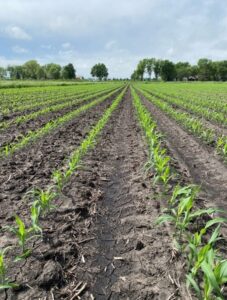
The number of kernel rows per ear is determined around V6, making it one of the most influential growth stages for corn.
Corn faces multiple challenges during V6, so keeping the competition away from the plant is critical. With weed pressure, Irlbeck’s advice is to start clean and stay clean.
“Use a good preemergence herbicide, multiple modes of action and make sure you’re going early if you’re just using a postemergence application,” says Irlbeck.
Growers should scout for other common V6 pressures like corn rootworm by digging roots and floating larvae. While it’s not possible to control corn rootworm once feeding is underway, Irlbeck notes that prevention is key and “stacking protective traits can help mitigate risk, as can a soil-applied insecticide.”
In terms of disease management, Irlbeck shares that “fungicides are critical if you’ve had disease in the past, especially in a corn-on-corn situation.”
Address nutrient deficiencies
The V6 stage is also when nitrogen uptake begins, so growers should be on watch for nutrient deficiencies and be prepared to correct them.
“You may see some sulfur or nitrogen deficiency,” says Irlbeck. “If you have it in your program to do some side-dress nitrogen, V6 to V8 is an optimal time because it’s not long until we’re pushing tassels.” Since corn uses up to 70% of its nitrogen before R1,* having the appropriate amount of nitrogen applied ahead of tasseling is crucial.
“The rapid growth period from V7 to tassel is when most of the nitrogen in that plant is taken up and used,” Irlbeck explains. “Make sure you have enough fertilizer up front or split-applied.”
Signs of success
You may start to see suckers or tillers appear on the plant at V6. In most cases, it’s not something to worry about. “Tillered corn is happy corn,” says Irlbeck. “That typically means it has enough nutrients and moisture that it thinks it can throw another stalk out there.”
His final way to maximize this growth stage — a cross-check on your management plan. “Make sure you’re talking to your agronomist who’ll know how to anticipate how hybrids will react to different management practices and get the best bang for your buck.”
For help with crop management and mitigating risk this season, reach out to your local LG Seeds agronomist.
###
Contacts:
Ashley Davenport | Ashley.Davenport@AgReliantGenetics.com | 574-780-0203
Julianne Johnston | jjohnston@morganmyers.com | 319-233-0502
The information and statements contained in this release are merely for informational and educational purposes and do not guarantee future performance.
ALWAYS READ AND FOLLOW IRM, WHERE APPLICABLE, GRAIN MARKETING AND ALL OTHER STEWARDSHIP PRACTICES AND PESTICIDE LABEL DIRECTIONS.
The LG Seeds Design and AgriShield are registered trademarks of AgReliant Genetics, LLC.
©2025 AgReliant Genetics, LLC.


