
FOR IMMEDIATE RELEASE
What’s Your Corn Field Hiding?
LG Seeds agronomist shares tips on avoiding yield-limiting nutrient deficiencies in corn.
WESTFIELD, Ind. (Oct. 22, 2024) – It’s easy to assume a corn hybrid and/or disease is to blame for a poor performance, but it’s often more complicated than that. LG Seeds Agronomist Justin Schneider urges farmers to go a little deeper and investigate whether nutrient deficiencies or imbalances factored into any shortfalls in their fields this fall.
Corn crossed the finish line on fumes
Schneider’s Michigan territory experienced ample rain much of the growing season, which resulted in leaching of sulfur and nitrogen. Late in the season, sulfur and nitrogen deficiency in corn became evident. “Corn plants died early and we’re crossing the finish line on fumes,” he reports. “Corn yields are strong, but we have some very weak stalks because of how we finished.”
By the time those nutrient deficiency symptoms appeared, options were limited other than pursuing a timely harvest and prioritizing fields by standability. “In-season soil nitrate testing could have clued farmers in to the shortfalls,” Schneider says.
Corn plants will identify nutrient deficiencies in various ways, whether it’s striping or yellowing or stunting or something else, Schneider points out. But by the time you see nutrient deficiency symptoms, you’ve likely already affected yield.
“You might be able to correct it and prevent additional yield damage, but you could have likely saved more if you had seen it coming,” Schneider says. Tissue sampling and in-season soil testing can give farmers more of a heads-up.
Many pieces to the yield puzzle
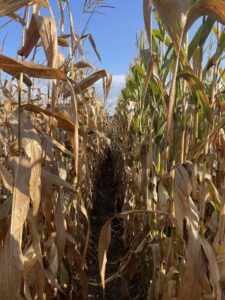
Nitrogen deficiency brought a swift end to the growing season for some farmers.
Farmers often focus on nitrogen, phosphorus and potassium, but Schneider says those aren’t the only nutrients farmers should pay attention to. Other micronutrients worthy of attention include boron, zinc, sulfur and manganese.
Boron is important for root development. Zinc helps the plant early in the season with germination and growth. Manganese is important from a disease standpoint. Sulfur is necessary for nitrogen fixation and plant function, according to Schneider. He encourages farmers to make sure their ratios and application rates are correct.
“They’re all pieces of the puzzle,” Schneider says. “If you’re missing one, the corn plant likely won’t see a dramatic yield impact, but it also won’t perform as best it can.” The biggest nutrient-related hits to yield typically come when a deficiency leaves a corn plant vulnerable to a disease like tar spot.
Other issues that can limit nutrient uptake
Application timing is a major factor since the crop uses nutrients at different points during the growing cycle. For instance, a corn plant needs boron when the ear is forming within the plant and after pollination when ears are elongating. Split applications can help make farmers more efficient with their use of boron.
Soil pH is another consideration. “You can apply all the nutrients you want, but if your soil pH isn’t balanced, your corn won’t be able to take advantage of available nutrients,” Schneider says. This is especially true with sandy soils that tend to be more acidic. Corn responds best when soil pH is around 6.8.
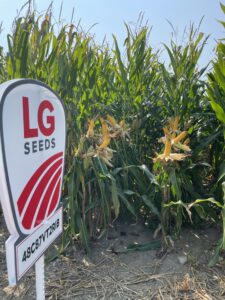
Look beyond N, P and K when thinking about soil health, advises LG Seeds Agronomist Justin Schneider.
Soil compaction can also limit nutrient uptake. “If the root system can’t penetrate the soil profile, the corn plant won’t be able to access the nutrients that are there,” Schneider says. Breaking up areas of hardpan might involve de-tillage or cover crops, depending on the farm operation.
Injury to a plant’s root system — whether that’s via root feeding, disease, nematodes or fertilizer burn — can also compromise nutrient uptake. Farmers should also keep moisture levels in mind when assessing crops’ nutrient needs. Too much moisture can move nutrients below the root zone, while too little can limit the plant’s ability to take nutrients up.
Make every bushel count
“Every bushel counts in this environment,” Schneider says, urging farmers to make sure a nutrient shortfall doesn’t prevent them from reaching yield goals.
Farmers can reach out to their local LG Seeds agronomist for support with soil testing, tissue sampling or applying their test results.
###
Contacts:
Ashley Davenport | Ashley.Davenport@AgReliantGenetics.com | 574-780-0203
Julianne Johnston | jjohnston@morganmyers.com | 319-233-0502
The information and statements contained in this release are merely for informational and educational purposes and do not guarantee future performance.
ALWAYS READ AND FOLLOW IRM, WHERE APPLICABLE, GRAIN MARKETING AND ALL OTHER STEWARDSHIP PRACTICES AND PESTICIDE LABEL DIRECTIONS.
The LG Seeds Design and AgriShield are registered trademarks of AgReliant Genetics, LLC.
©2023 AgReliant Genetics, LLC.


