
FOR IMMEDIATE RELEASE
Five Tips for Battling White Mold in Soybeans
LG Seeds agronomist provides advice to protect future soybean crops
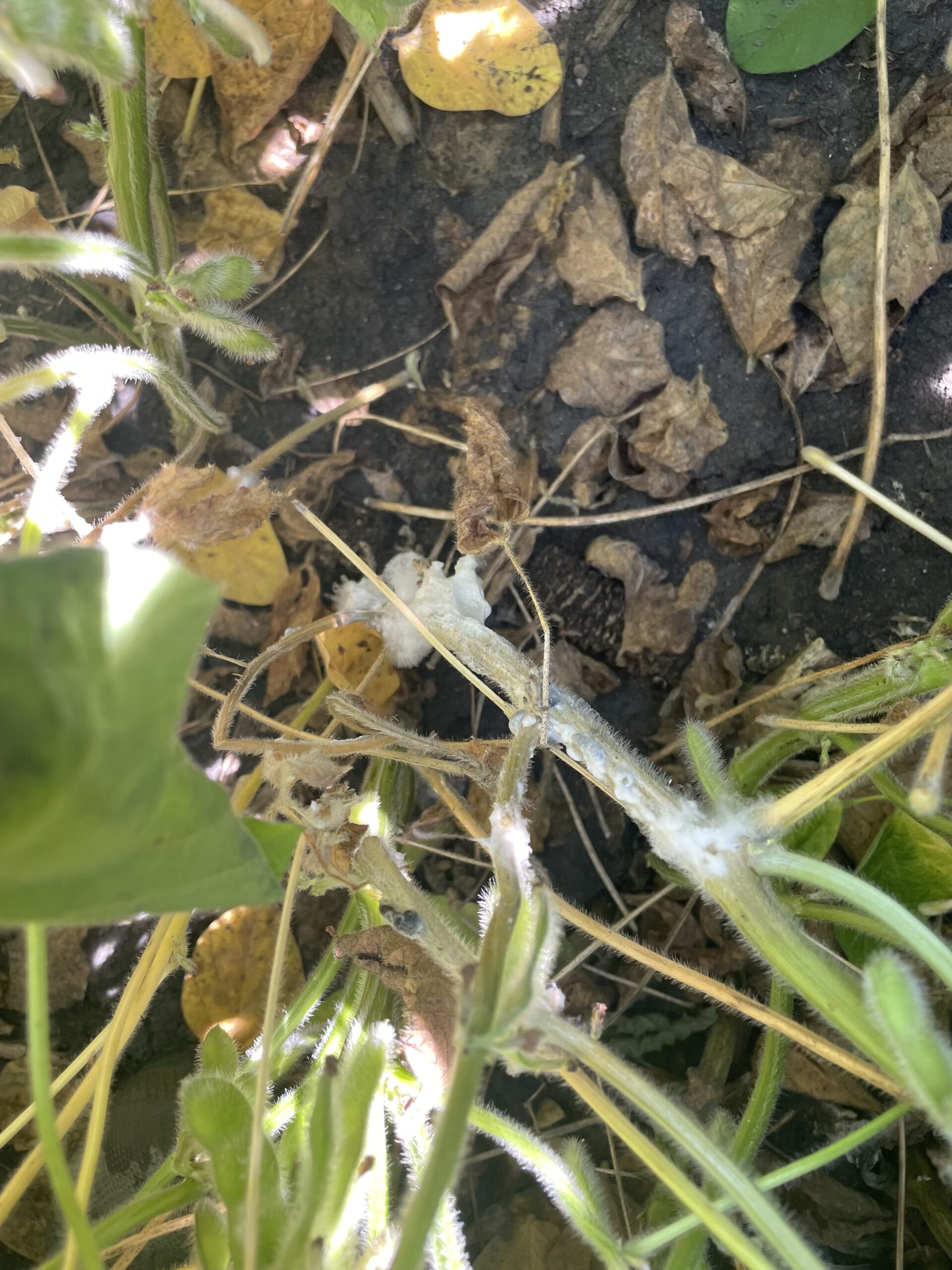
WESTFIELD, Indiana (Sept. 26, 2023) – White mold is prevalent in Michigan this year, impacting soybean yields, says Justin Schneider, a Michigan-based LG Seeds agronomist. He encourages farmers to scout fields now for the disease to be better prepared to protect soybean yields in the future.
Weather conditions favored white mold
The weather pattern of early season drought followed by record-setting rainfall later contributed to the spread of white mold. “We had a lot of moisture overall in Michigan,” says Schneider. “While May and June were dry, too much rain in July created a perfect storm for white mold to infect plants throughout the month.”
White mold develops after apothecia, or the fruiting bodies responsible for the reproduction of the fungus, on the soil surface shoot spores in the air, which land on senescing flowers and choke out the lifeline through the stem. “You end up finding either no soybean pods or a very small seed, depending on when the infection occurs,” says Schneider.
LG Seeds agronomist Justin Schneider says white mold is prevalent throughout Michigan.
Because soybean plants and the soil surface never dried out, disease pressure was at an all-time high for a large majority of the state. “Towards mid-to-late August, we started to see dead plants across fields from white mold girdling the stem.”
The extent of yield loss to white mold varies depending on the severity of the infection. Schneider estimates losses of 5% to 10%, and even higher in some areas with significant white mold pressure this year.
Schneider encourages farmers to focus on prevention strategies. “It’s all about the next couple of years now, looking deeper into your management practices and preparing yourself to better manage certain fields in the future,” he says. “With white mold inoculum in the soil, the best thing farmers can do now is work with their local agronomist to learn what could have been done differently.”
#1. Select tolerant soybean varieties
Schneider says selecting soybean varieties with a strong tolerance to white mold is the first line of defense. “Our team looks for the best agronomically tough bean that has high tolerance to white mold,” says Schneider.
He recommends LGS2001E3 and LGS2025XF for white mold tolerance. “LGS2001E3 is in all of our plots that don’t have white mold when everything else does,” he adds. “That, along with LGS2025XF, are the top two varieties in Michigan for anyone concerned with white mold.”
#2. Consider no-till
Because white mold lives in soil for seven to eight years, it’s always a threat. “You can plow it under, but it’s not going to go away,” says Schneider. “Once you till the ground again, it returns.”
That’s why Schneider says one of the best management practices for white mold is no-till. “The corn debris from last year is on the surface of the soil,” he says. “When white mold apothecia shoot spores up, it’s deflecting off the corn debris and has a more difficult time getting to the soybean flowers.”
#3. Strategic crop rotation
Rotating crops each year is important for any field, but to prevent white mold in soybeans, the type of crop planted the year prior is especially important.
“Crop rotation after sugar beets is a big deal in Michigan because after sugar beets, your soil is black,” Schneider states. “However, there’s little to no debris from sugar beets, so white mold can shoot their spores up very easily.”
For farmers experiencing this, he encourages planting corn after sugar beets before rotating back to soybeans. “The fodder from the corn puts more debris on the field and helps keep white mold levels down,” he adds.
#4. Fine-tune fungicide timing
There are fungicides available to protect soybean flowers while they’re senescing to help prevent white mold from infecting the plant. “You need to get ahead of white mold because once you find it, the plant’s already infected,” adds Schneider. “But if you’re using fungicide as a way of trying to protect, you can adjust the timing based on row spacings.”
Schneider says narrower soybean row widths require earlier applications. “As row spacings get narrower, fungicide needs to be applied earlier because the canopy is getting denser earlier,” he explains. “With 30-inch rows, you get a little bit more air movement longer in the growing season.”
Schneider recommends the following times for spraying fungicides:
- End of R1 to beginning of R2 growth stage for solid-seeded soybeans.
- End of R2 to early R3 growth stage for 15- to 20-inch rows.
- Closer to the R3 growth stage for 30-inch rows.
“With this being a very bad white mold year, farmers in the 15- to 20-inch row spacing might consider planting 30-inch rows on that field in the future,” he says.
#5. Balance soil fertility
Over-fertilization can lead to excessive plant growth and create favorable conditions for white mold. “If you’re planting soybeans on a field that used to be an old cow pasture and there’s been heavy manure on it for years, it’s probably best not to fertilize that field,” Schneider says.
Know your high fertility fields and manage accordingly, Schneider recommends.
For proactive and informed management practices to protect yields, reach out to your local LG Seeds agronomists or visit LGSeeds.com.
###
ABOUT LG SEEDS
LG Seeds is a dealer-driven national seed brand offering solid agronomic support, straightforward service and consistent plant performance that yields. LG Seeds’ portfolio of broad trait choices and tailored genetics brings corn, soybean, sorghum and alfalfa products to fit farmers’ performance goals. For more information visit LGSeeds.com and follow us on Facebook, Twitter, Instagram and LinkedIn.
ABOUT AGRELIANT GENETICS
AgReliant Genetics is committed to providing trusted seed solutions that help farmers grow. We do this by focusing solely on seed and delivering one-of-a-kind, high-performing hybrids. Founded in 2000 by global seed companies KWS and Limagrain, AgReliant Genetics benefits from direct access to a global corn germplasm pool and has a top four corn research program. Through our seed brands, AgriGold® and LG Seeds in the U.S. and PRIDE® Seeds in Canada, we proudly offer the latest innovation to our farmer customers, whether they grow corn, soybeans, sorghum or alfalfa. Discover more at AgReliantGenetics.com.
Contacts:
Ashley Davenport | Ashley.Davenport@AgReliantGenetics.com | 574-780-0203
Julianne Johnston | jjohnston@morganmyers.com | 319-233-0502
The information and statements contained in this release are merely for informational and educational purposes and do not guarantee future performance.
The LG Seeds Design and AgriShield are registered trademarks of AgReliant Genetics, LLC.
©2023 AgReliant Genetics, LLC.


