
FOR IMMEDIATE RELEASE
AgriGold: Slow-emerging Crops May Be Vulnerable to Pest Pressure
Farmers planting into cool, wet soils should prioritize seed with strong emergence
WESTFIELD, Indiana (May 4, 2023) – Each season brings a different set of disease challenges. Cool late-April weather that slowed soil warming has AgriGold Agronomist Nick Frederking concerned about below-ground pests like wireworm, white grub and seed corn maggots.
Frederking is concerned the insecticide protection included in a seed treatment could wear off before plants are ready to defend themselves. “That seed treatment is only active for 21 days,” he explains. “In an ideal season, the corn plant gets out of the ground within seven days and has protection for the next two weeks until the plant is big enough to defend itself. But if the plant is just emerging at two weeks, it will be more vulnerable to pest and disease pressure.”
Seed treatment protection has a shelf life
Frederking fielded a lot of calls from farmers in southern Illinois who were debating whether to plant as April wound down. “My advice has been to plant, but not to push,” he says.
While Frederking doesn’t expect germination issues, he warns fading seed treatment protection is an associated risk. “If you have a history of wireworm, white grub, seed corn maggot or have greenery in your fields, it’d probably be better to hold off on planting until things are a little warmer and the plant can actively grow while it has that protection with the seed chemistry,” Frederking says. “Wheat fields going to corn or soybeans may also face higher wireworm pressure.”
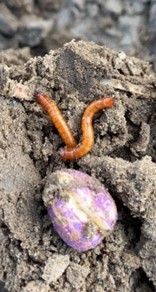
Slow-emerging seed may be vulnerable to damage from pests like wireworm.
Prioritize hybrids and fields
Farmers who opt to plant while soil is cool and moist should prioritize hybrids based on their emergence scores. Then they should decide where to plant.
“Greenery in the field presents the opportunity for higher pest pressure,” Frederking says, advising farmers to remove foliage as quickly as possible. It presents a place for adult pests to lay their eggs that hatch into black cutworm, fall armyworm and corn borers. “If you are in a cover crop situation, make sure you get the cover crop terminated in a timely manner,” he says.
Good furrow closure should be another priority. “If you’re not closing the furrow well, insects and slugs can make their way in,” Frederking says. “Slugs can devastate crops. They use a more open furrow as a highway and feed unrestricted on actively emerging seedlings.”
Management practices also come into play. “If you are in a no-till environment and like to plant early, you know slugs,” Frederking explains. “If you’re typically a conventionally tilled, May-planted farmer, you probably don’t.”
Below-ground pests can force replants, above-ground pests can threaten plant health
Scouting for white grub and seed corn maggots is tough because they are in the soil. Wireworms are a bit easier to scout because they come to the soil surface early in the season to feed. Farmers can use bait stations two to three weeks ahead of planting to gauge pressure.
The damage these below-ground pests cause is relatively immediate. “Once they feed on the seed, you’ve either lost the seed or compromised emergence, leaving the farmer with a replant decision,” Frederking explains. Black cutworm’s impact is similar; if cutworms clip enough plants, a farmer may need to replant. On the other hand, pests like corn borer, armyworm or corn earworm can induce stalk rot or open a plant to infection – impacts that can plague farmers season-long.
Farmers can minimize these above-ground threats with smart trait selection and insecticide application. The most effective ways to manage below-ground pests are with planting timing and seed treatments, according to Frederking. “Seed treatments are a good investment.”
For help making those difficult risk/reward decisions as the growing season gets underway, reach out to your local AgriGold agronomist.
###
ABOUT AGRIGOLD
AgriGold offers unique hybrids paired with the latest agronomic knowledge and data to achieve exceptional crop performance, year after year. Based in Westfield, Indiana, AgriGold is for the farmer who wants a true seed partner that is an ally in the field. For more information, visit AgriGold.com and follow us on Facebook, Twitter, Instagram and LinkedIn.
About AgReliant Genetics
AgReliant delivers one-of-a-kind, high-performing hybrids farmers can’t get anywhere else. Regardless of the brand on the bag – AgriGold®, LG Seeds or PRIDE® Seeds – count on AgReliant Genetics for unique, diverse genetics with formidable yield and multiple trait options. Our seed-only focus opens new innovation for our brands and for our farmer customers, whether they grow corn, soybeans, sorghum or alfalfa. Learn more at AgReliantGenetics.com.
###
Contact:
Amanda Fruland, Amanda.Fruland@agreliantgenetics.com
Julianne Johnston, jjohnston@morganmyers.com


