
FOR IMMEDIATE RELEASE
AgriGold: Soybean Architecture Study Helps Guide Farmer Seed Selection
AgriGold agronomist tests varieties’ ability to flex under low and high seeding rates
WESTFIELD, Indiana (Jan. 9, 2023) – For many years, soybeans have played second fiddle to corn, but expanding market opportunities have heightened attention on the oilseed. AgriGold Agronomist Nick Frederking saw an opportunity for farmers to build yields with more customized soybean variety placement.
“We know the corn plant has the ability to flex ear size,” Frederking explains. “Soybeans can also flex, but with soybeans you’re talking about hundreds of fruiting structures versus one for corn. There are a lot more variables involved.”
With that in mind, he started trials studying the plant architecture of 10 soybean varieties at both low and high seeding rates, studying the plants’ ability to genetically flex. “If I could separate plants by architectural differences, that could help farmers place and manage soybean varieties,” Frederking explains.
Parameters of the study on soybean architecture
Frederking chose 10 varieties for the 2022 trial on his research plot in southern Illinois with maturities ranging from 3.4 to 4.3.
“To see the maximum flex of these 10 varieties, I planted each at 80,000 seeds per acre in 15-inch rows. Then I planted those same varieties right next to it at 160,000 seeds per acre,” he explains. An average seeding rate for his area of the state ranges from 120,000 to 140,000 seeds per acre.
In a perfect year, Frederking would have planted in April, but a wet spring delayed planting until June 5. “The later planting date was challenging because soybean production is largely determined by how much vegetation can be put on before the day starts to get shorter after June 21,” he says.
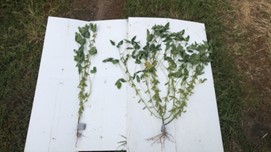
As the growing season progressed, he focused on capturing data and taking pictures to document architectural differences.
Diverse soybean plant responses to low and high seeding rates
Frederking reports for the low seeding rate, “There were some varieties that branched aggressively and others that would not branch.” Those narrow-lined “stick figure” plants loaded pods on the main stem, he details.
Frederking kept tabs on whether those branches were able to produce pods and subsequently seeds. “Any piece of vegetation on the plant requires energy,” he explains. “If a plant creates vegetation, I want to make sure its branches are being utilized to make seeds.”
Some varieties branched aggressively and made a lot of pods, while other branchy varieties didn’t do anything more than make vines, according to Frederking. He sums up the results as follows: “Now I have categorized how 10 varieties handle low seeding rates – some are narrow-lines, some that have the ability to branch and add pods, and some that branch out but do not convert the vegetation to pods.”
With the higher population trials, Frederking reports, “The narrow-lined ‘sticklike’ varieties that didn’t branch at the low populations also did well at high populations because they don’t need or want a lot of space. They genetically ‘want’ to grow vertically, not get wide.” Farmers will get their biggest bang for their buck planting those varieties in medium to higher populations, Frederking says.
When those branchy varieties were planted at a high population, the results were more of a mixed bag. “When you go to these higher populations, every variety becomes more sticklike naturally due to interplant competition for resources and sunlight. But they vary in terms of how well they branch at the low populations and in the ability to convert that energy to producing pods at a high seeding rate,” Frederking explains. Roughly half of those varieties did a good job converting that energy into pod production.
“From an architecture standpoint, my study showed more diversity with the XtendFlex® lineup. The Enlist E3® plants I tested tended to be branchier and shorter, on average, than the XtendFlex® varieties,” Frederking details, emphasizing this was specific to the varieties he tested.
Study enables better seed placement driven by farmers’ management styles
Frederking sums up his findings as follows: “We’ve learned there are some varieties that can compensate, regardless of the population. We’ve also learned that some varieties have no business being in a low population environment. And we’ve learned some need to be in a low population environment to maximize their genetic capability.”
When Frederking talks with farmers, he starts by asking about their current soybean planting practices. “I don’t want to change someone’s program if I don’t have to,” he explains. For the farmer working to back off populations to boost yield, Frederking says he’s now better equipped to direct them toward a soybean variety that branches out and maximizes that space, in addition to having the agronomic factors needed for that farm.
For farmers using a high seeding rate, Frederking can now direct them toward varieties that don’t need a lot of space to produce well.
AgriGold will expand the trials to include a wider range of geographies and maturities in 2023, with pilots planned as far north as North Dakota and Minnesota.
“Interest in soybeans is rising, and we’re excited to expand our understanding of AgriGold’s soybean varieties and how they perform at either end of the seeding spectrum,” Frederking explains. “It improves our ability to get it right, helping a farmer to place the best variety for his or her unique location and management style.”
###
ABOUT AGRIGOLD
AgriGold offers unique hybrids paired with the latest agronomic knowledge and data to achieve exceptional crop performance, year after year. Based in Westfield, Indiana, AgriGold is for the farmer who wants a true seed partner that is an ally in the field. For more information, visit AgriGold.com and follow us on Facebook, Twitter, Instagram and LinkedIn.
About AgReliant Genetics
AgReliant delivers one-of-a-kind, high-performing hybrids farmers can’t get anywhere else. Regardless of the brand on the bag – AgriGold®, LG Seeds or PRIDE® Seeds – count on AgReliant Genetics for unique, diverse genetics with formidable yield and multiple trait options. Our seed-only focus opens new innovation for our brands and for our farmer customers, whether they grow corn, soybeans, sorghum or alfalfa. Learn more at AgReliantGenetics.com.
###
Contact:
Amanda Fruland, Amanda.Fruland@agreliantgenetics.com
Julianne Johnston, jjohnston@morganmyers.com


